
Last Updated: November 24, 2026
Quick Summary
Renting ski boots usually costs less if you ski fewer than about ten days a season, while buying pays off in fit, comfort, and control if you ski more. The honest answer depends on your calendar, not your budget alone.
- Convert every rental program to an effective cost per day by dividing the total price by the days it covers.
- Build a break-even count from four inputs: realistic days on snow, rental cost per day, all-in purchase cost, and ownership lifespan.
- Season rentals can stay competitive well past the ten-day mark that generic advice cites.
- Beginners should rent first, because rental fleets let new skiers test flex ratings and shell shapes before committing.
- Reserve your boots ahead to save time and guarantee your size, whether you rent or buy.
Renting or buying boots this season?Carver’s Ski and Bike rents ski boots in Breckenridge with expert fittings and easy online booking.
Table of Contents
- Renting vs Buying Ski Boots: Which Fits Your Season?
- The Cost Comparison at a Glance
- What Ski Boot Rental Cost Really Adds Up To
- How Often You Ski Decides the Break-Even Point
- Why Ski Boot Fitting Changes the Math
- Ski Boots for Beginners: Rent First, Buy Later
- How Long Do Ski Boots Last and When to Replace Them
- Reserve Your Boots Before You Drive Up
- Frequently Asked Questions
Renting vs Buying Ski Boots: Which Fits Your Season?
The renting vs buying ski boots guide question comes down to one number: days on snow. If you ski fewer than about ten days a season, rental boots usually cost less and spare you storage headaches. If you ski more, owning boots pays off in fit, comfort, and control. At Carver’s Ski and Bike, the honest answer depends on your calendar, not your budget alone.
Here’s what most guides get wrong: they treat this as a pure money question. It isn’t. Boot fit drives how much you enjoy the day, and a sloppy rental shell can ruin a trip faster than any lift line.
The Cost Comparison at a Glance
Rental boots carry a low entry cost and a high long-run cost. Buying boots front-loads the expense but spreads it across every season you keep them. The break-even point depends on what you rent and what you buy, and on how many days you ski each season.
| Factor | Renting Boots | Buying Boots |
|---|---|---|
| Upfront cost | Low, pay per trip | Higher, one-time |
| Fit quality | Generic, varies by fleet | Custom fit to your foot |
| Storage and transport | None | You haul and store them |
| Replacement cycle | Handled by the shop | Your responsibility |
| Best for | Occasional skiers, beginners | Frequent skiers, growing confidence |
If you want to trim the rental side of the math, our guide on finding cheap ski gear rentals covers where the savings actually hide.
What Ski Boot Rental Cost Really Adds Up To
Ski boot rental cost is rarely just the sticker rate. Daily rentals, multi-day packages, season rentals, and demo programs each price differently, and add-ons like performance upgrades or damage insurance shift the total. A shop’s daily rate looks cheap until you multiply it by a five-day trip, then again by three trips, and then compare it to a season program you never asked about.
Daily, Multi-Day, Season, and Demo Rentals Compared
The rental market is broader than the daily counter, and the program you choose changes the cost math more than the shop does:
- Daily rentals suit one-off trips and travelers flying in without gear. You pay the highest per-day rate, but you commit to nothing and the shop handles storage, fitting, and replacement.
- Multi-day packages usually beat stacking single days, and the per-day rate drops as the number of days rises. Ask whether the package prices boots alone or boots plus skis, because bundled packages can hide a boot upgrade fee.
- Season rentals make sense for locals and second-home owners who ski often but do not want to commit to a purchase.
- Demo and performance rentals let you ski a higher-performance boot for a day or a weekend. They cost more per day than standard rentals, but they are the cheapest way to test whether a stiffer flex or a narrower last suits you before you buy.
The Fees and Add-Ons That Inflate the Bill
The sticker rate is only the start. Common add-ons include performance-upgrade fees for a stiffer or narrower boot, damage or loss insurance, and reservation or late-return charges. Some shops also charge separately for a fitting or for custom footbeds in rental boots. Ask what is included before you book, because hidden fees at ski shops can quietly inflate the bill. Our rental cost guide walks through the fees worth checking.
How to Compare Rental Programs Fairly
To compare programs on equal footing, convert every option to an effective cost per day: take the total program price, including add-ons you would actually pay, and divide by the days it covers. Then compare that number to your realistic days on snow. A season rental that looks expensive next to a daily rate can be the cheapest option per day once you ski more than a handful of times, and a demo rental that looks cheap per day can be the most expensive way to ski a full season.
Watch out: a season rental priced per season rather than per day can look like a large upfront number, but dividing it by your realistic days on snow often reveals a lower per-day cost than any multi-day package.
How Often You Ski Decides the Break-Even Point
Ski frequency is the single clearest signal, but “ski more, buy boots” is not actionable on its own. What you actually need is a break-even count: the number of days on snow at which the total cost of renting overtakes the total cost of owning. The number of days that makes buying worthwhile depends on fitting, maintenance, and replacement costs, as well as rental pricing and boot prices, which vary by shop and region.
A Transparent Break-Even Framework You Can Run Yourself
Rather than trust a single threshold, build the comparison from four inputs you can look up or estimate:
- Your realistic days on snow this season. Count booked trips and local days, not aspirational ones.
- Your effective rental cost per day. Take the shop’s multi-day or season rate, not the single-day sticker, and divide by the days it covers. Add any performance-upgrade or insurance fees you would actually pay.
- Your all-in purchase cost. Include the boot price, a professional fitting session, and any custom footbed or liner work. Budget a modest annual amount for maintenance and eventual replacement.
- Your expected ownership lifespan in seasons. Divide the all-in purchase cost by the number of seasons you expect to keep the boots.
The break-even day count is your annual ownership cost divided by your effective rental cost per day. If that number is below your realistic days on snow, buying wins on cost alone; if it is above, renting wins. Run the math with your own numbers rather than a generic threshold, because a cheap season rental and an expensive fitted boot can push the crossover in either direction.
What the Framework Reveals That a Single Threshold Hides
Three patterns tend to surprise skiers who run the numbers:
- Season rentals compress the gap. A season-long rental program can make renting competitive well past the ten-day mark that generic advice cites, especially for skiers who only ski weekends at one mountain.
- Fitting costs belong in the purchase side. A professional fitting and any custom footbed work are real ownership costs, but they also raise the performance value of the boot, which is why the cost comparison and the fit comparison have to be read together.
- Growing children reset the math every year. A child whose foot changes size each season rarely reaches the break-even point before outgrowing the boot, which is why rental and season-lease programs dominate for families.
For a broader picture of what a ski trip costs end to end, this comprehensive cost-of-skiing breakdown helps you judge whether owning boots fits your budget.
Why Ski Boot Fitting Changes the Math
Boot fit is where the spreadsheet stops telling the whole story.
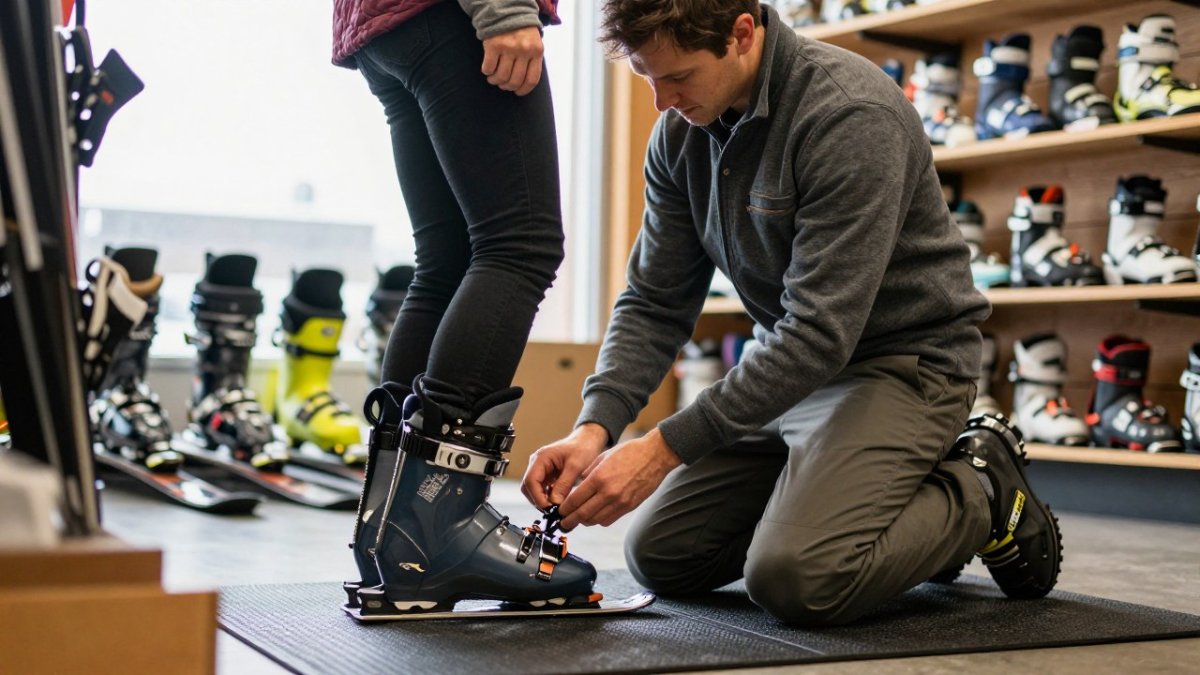
Foot shape and foot volume decide how much a generic shell will fight you. Pressure points, heel lift, and a sloppy cuff all sap control. If you’re leaning toward ownership, our step-by-step guide to fitting ski boots comfortably covers the process in detail.
Ski Boots for Beginners: Rent First, Buy Later
Beginners should rent. Renting boots exposes you to different flex ratings and shell shapes while your preferences are still forming, and buying before you know what you like is often premature. As Alpine Ski Center notes in its guidance on renting versus buying gear, rental fleets let new skiers test equipment before committing.
How Long Do Ski Boots Last and When to Replace Them
Ski boots generally wear out over time with regular use, as the liner packs out and the shell loses stiffness. Watch for a compressed liner, worn heel and toe plates, and a flex that feels softer than it did. Replace when fit degrades or the shell shows cracking. Storing boots dry, buckled loosely, and away from heat extends their life.
Reserve Your Boots Before You Drive Up
Whichever side of the math you land on, reserving ahead saves time and guarantees your size. If you’re renting, book early and pick up on arrival. If you’re ready to compare options, you can reserve ski rentals in Breckenridge online and skip the base-area line. Our local team matches gear to your ability and the day’s conditions, with demo, performance, and sport-level boots on hand. The National Ski Areas Association publishes safety guidance worth a read before any trip.
The real challenge isn’t the cost math, it’s matching your gear to how you actually ski. Carver’s Ski and Bike has fitted Breckenridge visitors since 1995, with a convenient online booking system, expert advice matched to your skill level, and a wide selection of demo, performance, and sport-level gear. Get started with Carver’s Ski and Bike and spend less time in the rental line and more time on the snow.
Frequently Asked Questions
Is it cheaper to rent ski boots or buy them?
It depends on how many days you ski. Rental ski boot cost is paid per trip, so occasional skiers who log a handful of days each winter usually spend less renting. Frequent skiers who ski many days per season often reach a break-even point within a season or two, after which owning boots costs less per day. Add up your expected days on snow, then compare that against the purchase price plus any boot fitting work.
At what point should I buy my own ski boots?
A common rule of thumb is to buy once you ski regularly enough that rental fees start to rival the purchase price, depending on how often you ski and what you rent. Buying also makes sense when rental boots cause pressure points or when you want a consistent fit and flex for performance. Beginners still exploring the sport should rent first, since preferences for flex and fit change quickly.
How long do ski boots last?
With regular use, ski boots generally wear out over time with regular use, as the liner packs out and the shell loses stiffness. How long a pair lasts depends on how often you ski. Proper drying, storage, and occasional liner replacement extend the life of your boots.
Are rental ski boots comfortable?
Rental boots vary in comfort depending on the shop and the condition of its rental fleet. Rental boots are built for durability and a wide range of feet, so they may feel less precise than a custom-fitted boot. Trying them on before you leave the shop and flagging pressure points early makes a difference.
Do ski boots need to be professionally fitted?
Professional ski boot fitting can improve comfort and control, especially for skiers buying their own boots. If you buy, budget for a fitting session to get the most from your purchase.
Can you rent ski boots without renting skis?
Yes. Renting boots separately from skis can help travelers who own skis but want to try a different boot. If you plan to rent only boots, confirm availability ahead of your trip.
